How to Read an Aurora Forecast
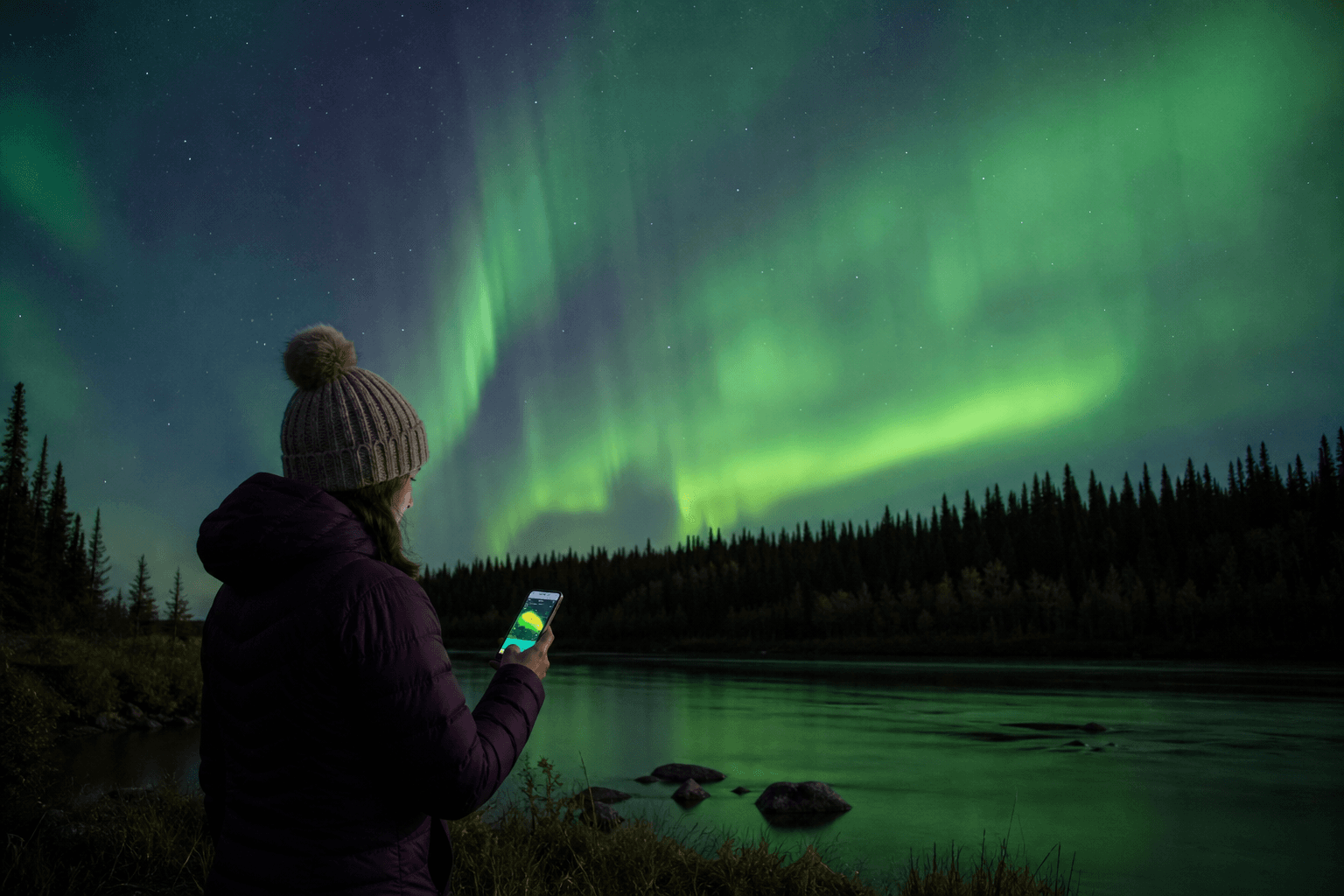
Reading an aurora forecast can look a bit intimidating at first. There are maps, numbers, strange acronyms, and enough glowing colors to make it seem like the sky is either guaranteed to explode or guaranteed to do absolutely nothing.
The useful version is much simpler: an aurora forecast helps you judge whether geomagnetic conditions, darkness, and your local sky are lining up well enough to make stepping outside worthwhile.
The short answer
If you only want the practical version, read an aurora forecast in this order:
- Check whether activity is strong enough for your latitude
- Check whether it will be dark where you are
- Check cloud cover
- Treat the forecast as odds, not a promise
A strong aurora forecast with thick clouds is still a cloudy evening. A weaker forecast under a dark, clear sky in a northern location can be much more useful.
Start with the question that actually matters
Most people are not really asking, "What is the KP index tonight?" They are asking, "Is tonight worth checking?"
That is the right question.
An aurora forecast is not one magic number. It is a mix of:
- Space weather conditions
- Your location
- Darkness
- Local weather
You do not need to become a space physicist to use it well. You just need to know which parts deserve the most attention and which parts are supporting actors.
First, ask whether the forecast is strong enough for your location
Auroras are easiest to see closer to the auroral oval, the high-latitude region where aurora activity is usually strongest.
That means the same forecast can mean very different things depending on where you are:
- In Alaska and northern Canada, modest activity can be enough
- In southern Canada and the northern U.S., you usually need stronger activity
- Farther south, you often need an unusually strong geomagnetic storm
This is why location-specific forecast pages are more useful than a single global headline. On this site, the U.S. forecast and Canada forecast are meant to do that translation step for you. Instead of asking whether the planet is active in general, you can ask whether your region has a realistic shot.
What the KP index does, and does not, tell you
KP is one of the most common numbers in aurora forecasts. It is a rough global measure of geomagnetic activity on a scale from 0 to 9.
The simple idea is:
- Higher
KPoften means the aurora can reach farther south - Lower
KPusually keeps the best activity farther north
That makes KP useful, but not complete.
What KP helps with:
- Getting a rough sense of how broad the geomagnetic activity is
- Judging whether lower-latitude locations may have a chance
- Comparing quiet nights to more active ones
What KP does not tell you well:
- Exactly when the aurora will brighten over your location
- Whether the display will be faint or dramatic
- Whether clouds will block it
- Whether short-lived bursts will happen at the right time
If you want the deeper background, why the aurora is hard to predict explains why no single forecast number can do all the work.
Darkness and cloud cover deserve equal billing
People often focus on space weather and forget the sky above their own head.
For casual aurora watchers, these two filters are just as important as the activity level:
- Is it actually dark enough?
- Is the sky actually clear enough?
If the answer to either is no, the forecast becomes much less useful.
That is why you should read an aurora forecast as a layered decision:
- Are geomagnetic conditions promising?
- Is it dark at my location?
- Are the clouds cooperating?
- Can I get somewhere darker if city lights are a problem?
This sounds obvious once stated plainly, but it saves a lot of disappointment. Many "bad forecast" nights are really "good space weather, bad local sky" nights.
If you want more detail, watch Bz, solar wind speed, and timing
Some forecasts and apps show more advanced values like Bz, solar wind speed, and density. These can be helpful, especially closer to the viewing window.
The most important one to know is usually Bz.
Bz describes the direction of part of the interplanetary magnetic field carried by the solar wind. If Bz stays southward for a while, energy tends to couple into Earth's magnetic field more efficiently, which can increase aurora activity.
Practical translation:
- Southward
Bzis often favorable - Faster solar wind can help energize conditions
- Short-term updates matter more as the event gets closer
This is one reason aurora forecasts improve at short range. Some of the most important details only become clear shortly before the best activity, which is also why the sky occasionally waits until you have almost given up and gone inside.
Bright forecast maps are helpful, but they are not a guarantee
Aurora maps are useful for showing where activity may be concentrated, but they are easy to overread.
A bright oval on a map does not automatically mean:
- The aurora will be obvious to the naked eye where you are
- It will peak during your local nighttime
- It will rise high above your horizon
- The show will stay active long enough for you to catch it
The map is best used as context, not as a promise.
If the map looks strong but the display stays faint, substorms and timing may be the missing piece. What a substorm is covers why auroras often intensify in shorter bursts instead of behaving like a steady light switch.
How to use the forecast on this site
The most practical way to use this site is to start from the location that matches where you are watching.
Use the forecast pages to answer:
- What are the current chances near me?
- What are the chances later tonight?
- Are nearby cities showing better odds?
That matters because local interpretation is the whole game. A broad forecast for North America is interesting, but a city or region page is more helpful when you are deciding whether to drive 20 minutes, 2 hours, or nowhere at all.
For most readers, a sensible routine is:
- Check your country forecast page
- Open the city page closest to where you are watching
- Compare current and later conditions
- Check local cloud cover separately
- Recheck closer to the time you plan to head out
If you also use aurora alerts or apps, treat them as one more signal rather than the final verdict. The goal is a better decision, not perfect certainty.
Common mistakes when reading an aurora forecast
These are the mistakes that trip up beginners most often:
- Treating a high
KPvalue as a guarantee - Ignoring cloud cover
- Forgetting that summer twilight can wash out the aurora
- Expecting one exact start time
- Assuming a global forecast means your backyard will light up
Forecasts work better when you think in terms of improved odds. The northern lights are cooperative enough to reward preparation, but not so cooperative that they will stick to a tidy appointment slot.
The bottom line
To read an aurora forecast well, focus on the few factors that matter most: activity level, location, darkness, and cloud cover. KP is useful, Bz can be very useful, and bright maps are helpful context, but none of them replace local conditions.
If you want the simplest next step, start with the U.S. forecast or Canada forecast, then compare that forecast with your sky. That combination is usually much more useful than chasing one exciting number on its own.